

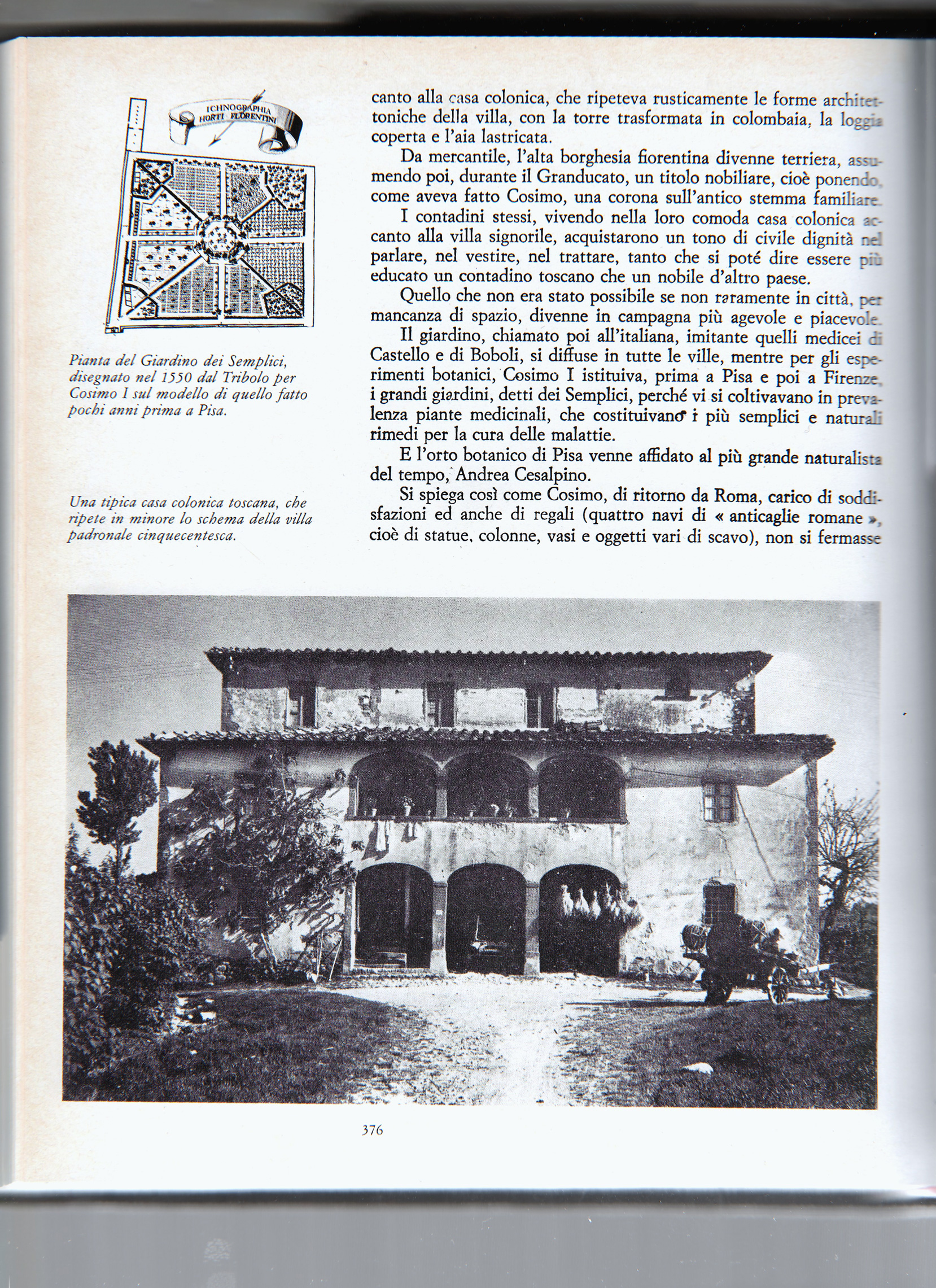
From mercantile origins, the Florentine upper bourgeoisie became landowning, eventually acquiring noble titles during the Grand Duchy period—placing, as Cosimo had done, a crown atop their ancient family crests. The peasants themselves, living in their comfortable farmhouses beside the noble villas, acquired a tone of civil dignity in their speech, dress, and manners—so much so that it was said a Tuscan peasant could be more refined than a nobleman from another region.
The first rural houses in Tuscany date back to the 16th century, when buildings began to be constructed in the countryside to house the families of tenant farmers and peasants. In the 18th century, the agrarian reforms that affected the Grand Duchy of Tuscany gave further impetus both to the construction of new farmhouses and estates and to the renovation of those from earlier periods. An important contribution to the study of rural houses was made by Ferdinando Morozzi, who in 1770 published a treatise on peasant houses in Tuscany.
Common as a modest country house in Tuscany and Latium, the type later provided one of the models for the construction of new farmhouses. In the late 18th century it was selected as the standard design throughout much of Tuscany, the ideal farmhouse that would symbolize the improved condition of, and enlightened attitude toward, the peasant farmers of the region.
An integral part of the local landscape, la casa colonica has now found new life as a modern rural retreat in the form of a luxury farmhouse, yet it still remains an authentic testament to a centuries-old agricultural tradition of the region.

Image and historic facts from The Splendid History of Florence by Piero Bargellini
Sabini & Associates archives
Additional sources:
Claudia Lazzaro, Rustic Country House to Refined Farmhouse: The Evolution and Migration of an Architectural Form